INTRODUCTION
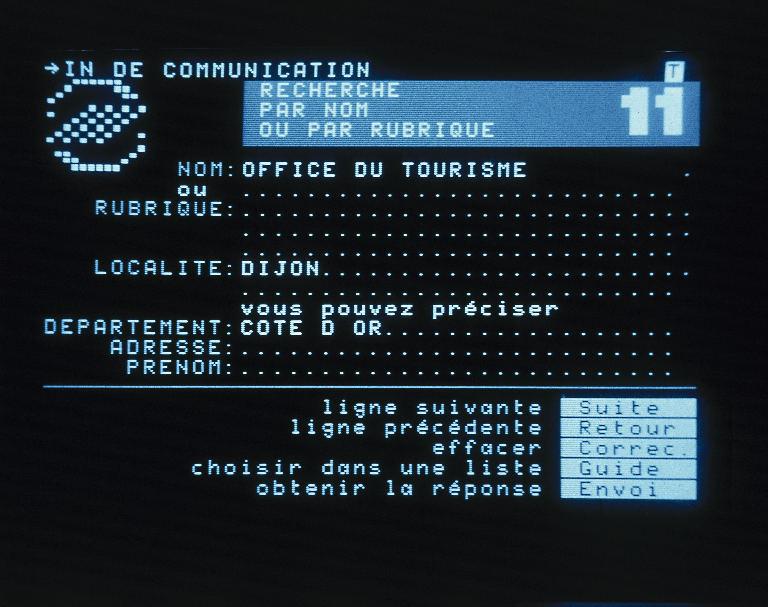
The Minitel was a videotex online service accessible through telephone lines, and was the world's most successful online service prior to the World Wide Web. It was invented in Cesson-Sévigné, near Rennes in Brittany, France.
The service was rolled out experimentally on 15 July 1980 in Saint-Malo, France, and from autumn 1980 in other areas, and introduced commercially throughout France in 1982 by the PTT (Postes, Télégraphes et Téléphones; divided since 1991 between France Télécom and La Poste). From its early days, users could make online purchases, make train reservations, check stock prices, search the telephone directory, have a mail box, and chat in a similar way to what is now made possible by the World Wide Web.
In February 2009, France Télécom indicated the Minitel network still had 10 million monthly connections. France Télécom retired the service on 30 June 2012.
Officially TELETEL, the name Minitel is abbreviated from the French title of Médium interactif par numérisation d'information téléphonique (Interactive medium for digitized information by telephone).
GROWTH
By early 1986 1.4 million terminals were connected to Minitel, with plans to distribute another million by the end of the year. To reduce opposition from newspapers worried about competition from an electronic network, they were allowed to establish the first consumer services on Minitel. Libération offered 24-hour online news, such as results from events at the 1984 Summer Olympics in Los Angeles that occurred overnight in France. Providers advertised their own services in their own publications, which helped market the overall Minitel network. Others founded newspapers solely to create Minitel services.
By 1988 three million terminals were installed, with 100,000 new units installed monthly. The telephone directory received 23 million calls monthly, with 40,000 updates daily. About 6,000 other services were available, with 250 added monthly. France Télécom estimated that almost 9 million terminals—including web-enabled personal computers (Windows, Mac OS, and Linux)—had access to the network at the end of 1999, and that it was used by 25 million people (of a total population of 60 million). Developed by 10,000 companies, in 1996, almost 26,000 different services were available.